Custom & non-standard · to drawing

Custom mold bases, machined to the tolerance you specify

Non-standard plate sizes, offset guide pillars, stepped pockets, non-standard cooling layouts — the jobs standard catalogues refuse. We review your drawing in 24 hours, quote the tolerance we can hold, and ship with the CMM report that proves it.

±0.005 mmPrecision fits
±0.001 mmCoordinate grinding
24 hDrawing review turnaround
15 yearsMold base manufacturing
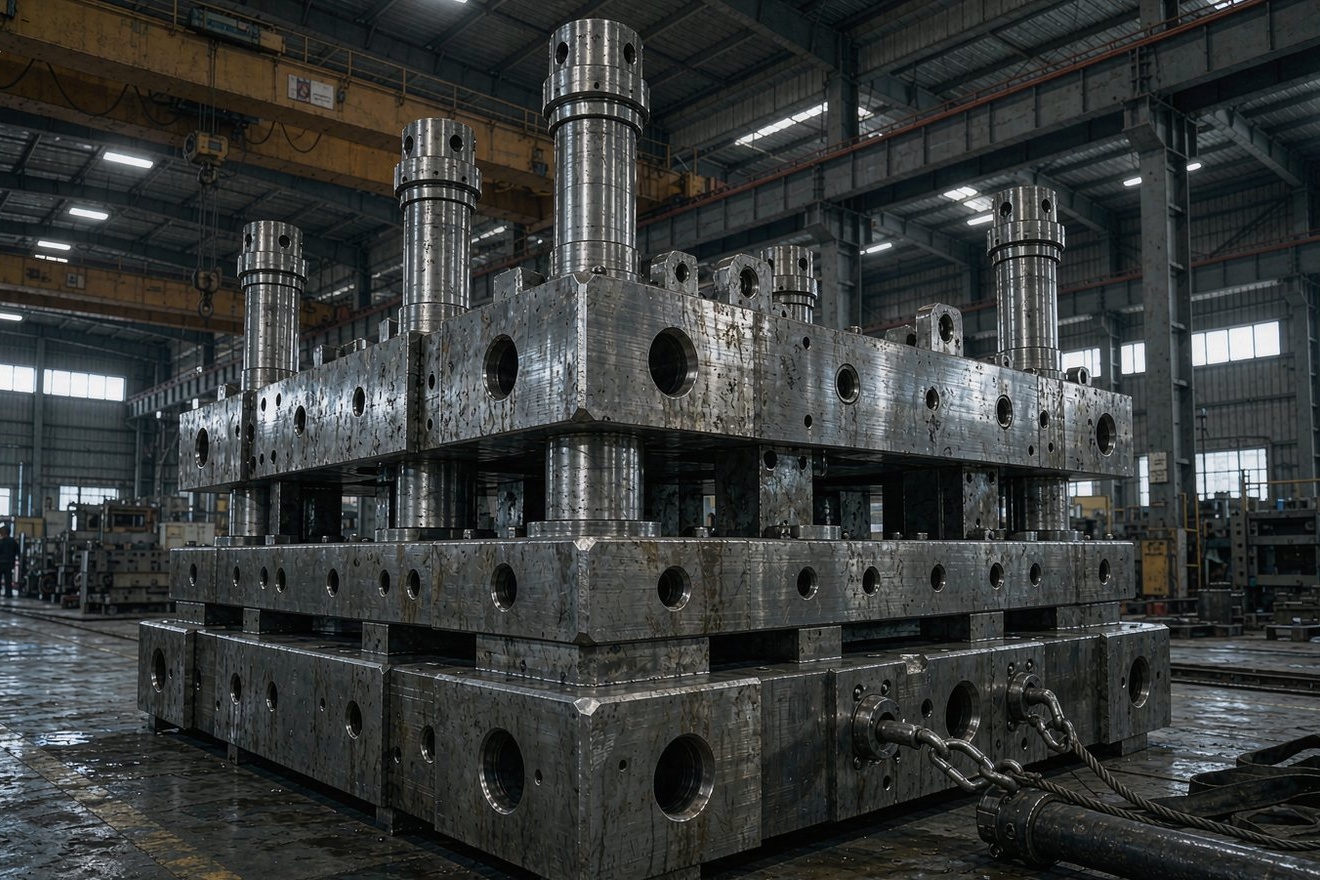
Custom mold base plates with stepped pockets and cooling bores under inspection
National High-Tech Enterprise certified in China CMM report per shipment Stress-relieved thick plates 1-off to 200/yr batch sizes
Custom work

The bases that do not fit a catalogue

A custom base fails in one of two ways: the geometry cannot be machined as drawn, or it can but moves after machining. We deal with both before the steel is cut.

01

Non-standard frames

Plate sizes outside the standard table, asymmetric layouts, cut-outs for slides and lifters, extended clamping edges for oversized platen.

Fully custom
02

Offset and stepped structures

Offset guide pillars, stepped parting lines, raised pads, unequal plate thickness — machined from one setup where possible to keep alignment.

To drawing
03

Thick-plate stress control

Plates over 150 mm are roughed, stress-relieved, then finished, so flatness survives the first 10,000 cycles instead of the first week.

≤0.02 mm/300 mm
04

Cooling and hot-runner integration

Deep-hole drilling to Ø30 × 1200 mm, baffles, hot-runner manifold pockets and wiring channels machined into the frame.

Ø3 – 30 mm
05

Insert and core pockets

Insert pockets held to ±0.005 mm with matched corner radii, so the insert sits without shimming or hand fitting.

±0.005 mm
06

One-off and repeat batches

Prototype single sets and annual frame agreements with dimension records kept, so a repeat order matches the first one exactly.

1 – 200 sets/yr
Tolerances

The numbers behind the claim

Custom work is judged on the fits that matter: guide-pillar bores, insert pockets, plate flatness and squareness. These are the values we inspect and report.

ItemRange / StandardNotes
Frame sizeUp to 2000 × 1300 × 800 mm machining envelopeLarger frames sectioned and assembled, joint faces machined after assembly
General machining±0.01 mmNon-fitting surfaces, clearances, reliefs
Precision fits±0.005 mmInsert pockets, guide-pillar bores, locating seats
Coordinate grinding±0.001 mmGuide-bush bores, precision bore repair
Flatness≤0.02 mm per 300 mm after stress reliefMeasured on granite plate
Squareness≤0.01 mm per 100 mm between adjacent facesCMM verified
Surface roughnessRa 0.4 – 1.6 µmChosen by function, not by default
Materials45#, 40Cr, P20, 718H, S136, NAK80, S50C, H13 for die castingMill certificate per heat number
InspectionFirst-article + final CMM, report in PDF with the shipmentDimensional record kept for repeat orders

Values are our routine capability, not a marketing ceiling. Anything outside the range goes through a technical review first — we confirm feasibility before quoting, and we do not promise what the machines cannot hold.

How we work

How a custom base gets built without surprises

Every custom job is a small project. The sequence below is what keeps a 6-week mould build from slipping because of a 2 mm pocket error.

01

DFM review of your drawing

We check wall thickness, bore depths against drill reach, corner radii against cutter size, and flag anything that would need EDM instead of milling. You get the marked-up drawing back.

24 hours
02

Quote with tolerance stated

The quote lists dimensions we will hold, the ones we cannot, and the price difference if you need the tighter class. No hidden "as per drawing".

1 day
03

Rough machine and stress relieve

Material cut with allowance, roughed, stress-relieved in furnace, then checked for movement before finish machining starts.

3–6 days
04

Finish machine and fit

Bores, pockets and faces finished; insert pockets trial-fitted with the actual insert where supplied.

4–10 days
05

CMM, report, ship

Final inspection on the CMM, report compared against the first article, crate packed with the dimensional record inside.

1–2 days

A drawing and a deadline is enough to start

Send the drawing even if it is not finished — we would rather flag a problem at sketch stage than quote a base that cannot be machined. Review is free, and it is the fastest part of the project.

Email
sales@layjun.cn
Mobile / WeChat
+86 138 2921 4701
Workshop
Dongguan, Guangdong, China
FAQ

Custom mold base questions, answered plainly

Straight answers to the questions buyers actually ask before the first order.

What drawings do you need to quote a custom mold base?
A 2D PDF or DWG with plate sizes, thicknesses, bore positions and tolerances, plus a 3D STEP if the geometry is complex. If you only have a 3D model, we can generate the 2D from it. Mark the critical fits — everything not marked is machined to general tolerance.
Can you hold ±0.005 mm on a plate 500 mm thick?
On fits, yes, provided the plate is stress-relieved before finishing and the feature is reachable by the jig grinder or a boring head. What we will not do is quote ±0.005 mm across a 2000 mm face — that is a different class and needs a different process. The quote states which is which.
How do you stop a thick plate from warping after machining?
Rough machining leaves 1.5–3 mm of stock, the plate goes through stress relief, then finishing removes the remainder symmetrically from both faces. Plates above 150 mm are checked for flatness after relief, before the finish cut, so a moving plate is caught early instead of at final inspection.
Do you machine the insert pockets from the same setup as the guide bores?
Where the geometry allows, yes — a single setup keeps the relationship between the guide system and the cavity pocket, which is what actually determines part quality. If the pocket needs a second setup, the bores are used as the datum and the offset is verified on the CMM.
What is the minimum order for a custom base?
One set. A large share of our custom work is single prototype frames; the setup cost is quoted separately so you can see what the one-off premium actually is, and what it drops to at 5 or 20 sets.
Can you work to our own corporate standard instead of HASCO or DME?
Yes. Send the standard document or a sample drawing; we build a machining template from it and keep it on file, so every later order uses the same plate table, bore schedule and inspection plan.
Contact

Send the drawing — free review, no obligation

Nothing on this page replaces looking at your actual geometry. Send what you have and we will tell you what is straightforward, what is expensive, and what we would change.

What to send with your enquiry

  • 2D drawings (PDF/DWG) or 3D model (STEP/IGES) of the mold base or plates
  • Plate sizes, thicknesses and the standard you design to (HASCO / DME / LKM or your own)
  • Steel grade and hardness, if already specified
  • Cavity count, injection machine tonnage and mold height limits
  • Special features: slides, lifters, hot-runner cut-outs, cooling layout, two-shot structure
  • Target quantity and required delivery date

Direct lines

Mr. Ma (马总)
Mobile / WeChat: +86 138 2921 4701
Tel: +86 769 82986196
Email: sales@layjun.cn

No. 6 Dong’ao 3rd Road, Hengli Town, Dongguan, Guangdong, China

Working hours: Mon–Sat 08:00–20:00 (GMT+8)

Email your drawings